

Advanced Major Projects System (AMPS)
Strategic Delivery Office
Matrix Paradigm
AMPS is a matrix-based paradigm for the strategic management of major infrastructure projects. It is founded on rigorous research into the repeatable conditions and decision drivers that consistently influence project success or failure. The methodology brings all key stakeholders into a single, integrated framework, aligning objectives and responsibilities early to prevent duplication, misalignment, and wasted effort.


Investment cycles
Major programs pose distinctive challenges for owners and investors, particularly at the front end of the investment cycle where decisions disproportionately shape long-term outcomes. AMPS is designed explicitly to address this challenge. It applies a two-dimensional matrix that aligns information, decisions, and outcomes across the three investment phases—planning, development, and implementation—and across the strategic, tactical, and operational layers of management.
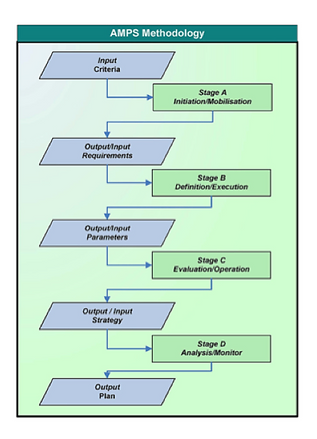
The AMPS architecture is built around six integrated “Tiles.” Each Tile comprises nine components and four defined stages, creating a vertically aligned system in which interdependent processes share information and progress coherently. At every stage, each process has clearly defined inputs and outputs, ensuring discipline, transparency, and continuity.
Processes are supported by stage-specific process flow maps that define the activities forming the Work Breakdown Structure (WBS). These maps also establish a consistent reference for best practice, guidance, and work instructions, providing a repeatable and auditable foundation for major project delivery.
Components
Major projects succeed not through isolated expertise, but through the disciplined coordination of specialist knowledge. AMPS captures this by classifying the knowledge required to generate outputs at each stage of the investment lifecycle into nine structured components, creating a coherent and repeatable delivery framework.

Stages
The core philosophy of AMPS is to make decisions only when they are required and only on the basis of reliable, aligned information. This places a premium on the availability, quality, and integration of information across key components, enabling clients to make informed decisions with confidence at each point in the lifecycle.
Key Principles
-
Each Phase “Tile” is structured into four defined stages.
-
Every stage has clearly defined information inputs and outputs.
-
Inputs and outputs are progressively developed and reviewed as the project advances.
To support controlled progression, AMPS applies structured assessment reviews throughout the project lifecycle. These reviews test the required outputs established by AMPS to confirm readiness to proceed. At each stage (A to D), a selected subset of the nine components is assessed within each investment phase, providing targeted assurance while maintaining flexibility and proportionality.